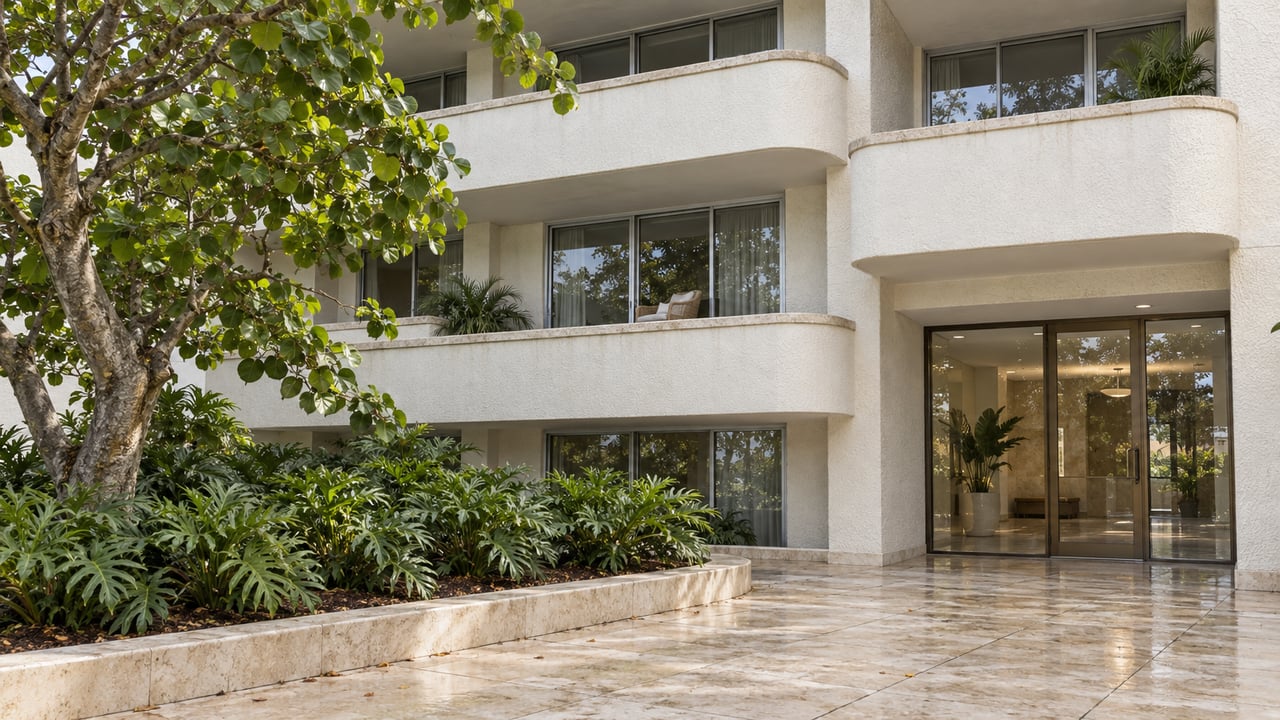
"The offer that we made was more than what the land was really worth for us in today's market." That is how the sales agent representing BH Group described its bid for the Mutiny in an interview with the Coconut Grove Spotlight after the $160 million offer expired in late August without the 80 percent owner approval Florida law requires.
The Mutiny is a 12-story building on South Bayshore Drive. Built in 1968, it was Coconut Grove's first high-rise, and this was the third attempt in less than two years to buy out its owners. Over roughly the same period, three low-rise Grove condominiums built in the 1960s were bought out. One of them was resold less than a year later for nearly three times what the first buyer paid.
Some older Grove condos now carry two prices. One is the price at which someone will buy a unit to live in it. The other is the price at which someone will buy the whole building for the ground under it. If you're comparing an older Grove condo with something newer elsewhere in Miami, the second price affects what you're buying, and the Mutiny shows what it takes for that second price to become an actual sale.
Three Buildings, Three Per-Unit Prices
The completed buyouts give a rough local price list for what developers have paid per apartment on these sites.
| Building | Units | Buyer | Price paid | Per unit | Reported use |
|---|---|---|---|---|---|
| Chateau Grove, 3265 Virginia St. | 25 | Canero Group | $17.2M to $17.3M, May 2025 | about $688,000 to $692,000 | Converted to rentals |
| Virginia Pointe, 3245 Virginia St. | 59 of 66 | Canero Group and 8K Capital | $27.7M, reported March 2026 | about $470,000 average | Rentals, no immediate redevelopment plans |
| The Bayshore Park | 39 | BH Group and Mast Capital | about $28M, completed by March 2026 | about $662,000 for the first 32, about $986,000 for the final 7 | Assembled for redevelopment |
The Chateau Grove price appears as $17.3 million in The Real Deal's May 2025 report and as $17.2 million in its March 2026 coverage, so the table shows both.
The Bayshore Park row shows how these deals work. The Real Deal reported that the first 32 units cost $21.1 million, or about $661,843 each. The last seven cost about $6.9 million, or roughly $985,714 each. That works out to about 49 percent more per unit for the owners who sold last.
Why the Last Owners Get Paid More
The math changes near the end because of how Florida Statutes section 718.117 handles optional termination of a residential condominium. Under the statute:
- At least 80 percent of the total voting interests must approve a plan of termination before it goes to the state.
- If 5 percent or more of the voting interests reject the plan, by vote or written objection, it cannot proceed, and another optional plan cannot be considered for 24 months.
- When a single bulk owner holds at least 80 percent of the voting interests, the other owners must receive at least 100 percent of fair market value, as set by an independent appraiser.
- In that same bulk-owner situation, owners whose unit has a homestead exemption receive a relocation payment equal to 1 percent of the termination proceeds for their unit, on top of those proceeds.
- If a homestead owner is also current on assessments and other monetary obligations to the association, the fair market value used for their unit can be no lower than the original purchase price.
This is general information, not legal or financial advice. Anyone weighing a termination plan or a unit in a building facing one should have their own attorney review the statute and the plan.
With a 5 percent blocking threshold, a small group of owners can stop a deal. In a 39-unit building, two units are already more than 5 percent of the units. This is unit math only, because voting interests are set by each building's declaration. As a developer gets closer to the 80 percent it needs, the owners still holding out have more leverage, which helps explain why Bayshore Park's last seven units cost about $986,000 each.
What the Land Was Worth a Year Later
Chateau Grove shows why developers pay these premiums. In April 2026, El-Ad National Properties paid $45.5 million for the 1963, two-story, 25-unit building, which Canero had bought out roughly a year earlier for about $17.3 million. As of the Spotlight's June report, El-Ad had not announced its plans for the site. At $45.5 million, the price works out to about $1.82 million per former apartment.
The added value comes from what the site could hold, not from the building on it. Chateau Grove's T4-L zoning allows a three-story building. A developer could build taller and denser by using City of Miami development incentives or Florida's Live Local Act. Spencer Morris of Allen Morris Company, which is developing Ziggurat on Grand Avenue, told the Spotlight that land values in the Grove "have surpassed the improvement values of the existing buildings." He added that replacing a two-story building with another two-story building would not make economic sense, so a site has to be "dramatically" densified for the numbers to work.
So when you look at a low-rise 1960s building in the Grove, the land value depends on three things: how much more the zoning would let someone build, whether incentive programs apply, and how many owners are on the deed. The unit's own comps are only part of what you're pricing.
Why the Mutiny's Premium Fell Short
On paper, the Mutiny offer looked generous. The buyer's agent told the Coconut Grove Spotlight that the individual offers came to "somewhere between 70 and 100 percent over" market value, based on the building's last closed sale. Earlier bids had a similar structure. DaGrosa Capital's approach beginning in December 2024 came with preliminary indications of at least $1,000 per square foot. Slate Property Group's $160 million proposal in February 2025 depended on city and county redevelopment approvals.
The Spotlight's reporting points to two reasons the latest offer did not clear.
The first is the cost of buying again in the Grove. One owner who bought in 2023 told the Spotlight the offer was a "pretty good price," but that after looking at other Grove properties, the proceeds would buy "little, if anything" in the area. He said rising Grove prices and the Mutiny's relative affordability played a major role in owners' decisions. A premium over a unit's last sale does not help much if the seller can't find a comparable home nearby with the money.
The second is the special assessment. BH Group had been told to expect a special assessment of roughly $30 million, which its agent estimated at about $130,000 per unit. An assessment that size gives owners a strong reason to sell. Then the board shared a figure that the Spotlight described as "much less," mostly for exterior work such as painting and resealing doors and windows. The association's board president told the Spotlight that the $30 million figure never came from the building. The approved amount has not been published.
BH Group's representative said the company is "sitting on the sidelines" and would return if owners wanted to sell. Recent reporting has not shown a new bid since the August 23 deadline.
The County Market These Buildings Sit In
For context, the MIAMI Realtors report for August 2026 shows 11,495 active condo and townhouse listings in Miami-Dade and 12.1 months of supply. The median sale price was $408,000, down 0.5 percent from a year earlier. Sellers received a median 94.0 percent of original list price, up from 92.4 percent in August 2025. These figures combine condos and townhouses across the whole county, not just the Grove.
The Real Deal's October 7 coverage describes a growing gap between older and newer buildings. Milestone inspections generally apply to condo buildings three stories or taller once they reach 30 years old, or 25 years near the coast, and most associations must begin fully funding reserves by the end of 2026. Analysts quoted there say buildings with assessments, higher monthly costs or major upcoming work face price pressure, though conditions vary from building to building.
In the Grove, those same costs can push owners toward a developer. A large assessment hurts a unit's resale price, but it also makes a buyout offer easier to accept. A small assessment, like the one Mutiny owners received this summer, makes it easier to stay. When you look at an older Grove building, its repair bill tells you both what you will owe and how likely it is that a developer could buy out the building.
Reading an Older Grove Building Before You Offer
The building documents and public record can tell you most of what you need. Before you make an offer, find out:
- Buyout history. Has the building received a termination proposal, and when? Under section 718.117, a rejection by 5 percent or more of voting interests blocks another optional plan for 24 months.
- Concentrated ownership. Does one investor or related group already own a large share of the units? Virginia Pointe shows how quickly that can happen.
- The assessment figure and its source. Is it the board's approved number, an engineer's estimate or a number circulated by a prospective buyer? At the Mutiny, those figures differed widely.
- Zoning and incentives. What does the site's zoning allow, and could incentive programs or the Live Local Act add density?
- What it costs to buy again nearby. At the Mutiny, that number shaped owners' decisions more than the size of the premium.
If you own in an older Grove building, or you're weighing one against a newer building elsewhere in Miami, I'd be glad to help you work out both prices for that specific address and what each one depends on. Max Mlekus works with these decisions in English and Italian. Let's Connect.