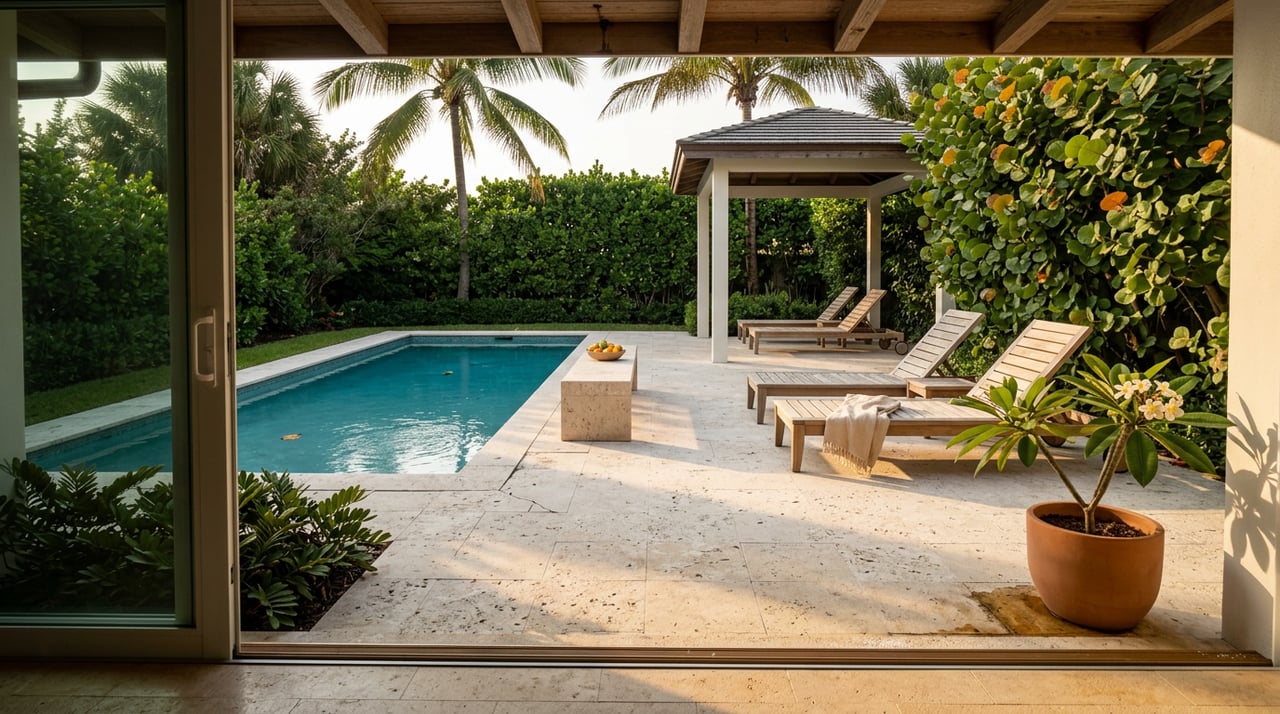
For seven months in 2025, the biggest gate on the island stayed shut. Residents who walk their dogs along Grand Bay Drive got used to the quiet: no valets, no arriving town cars, no laughter drifting off the pool deck at dusk. The Ritz-Carlton had closed for its first full renovation in nearly a quarter century, and with it went a set of habits many Key Biscayners barely registered as habits at all. The Sunday brunch after tennis. The drink at Rum Bar before a dinner reservation in the Grove. The spa gift card for a birthday. All of it, gone until further notice.
It came back on December 8, and the version that returned is not the version that left.
The thesis of this post is simple. The Ritz was never just a hotel to the people who live here. It was the island's shared living room. Its return, alongside a handful of quieter openings around The Square, has reset what "going out" means on the Key without ever crossing the Rickenbacker.
A Quarter-Century Reset, Priced at $100 Million
Numbers first, because the scale of this project matters. The Ritz-Carlton Key Biscayne reopened on December 8, 2025, following the completion of a $100 million renovation, its first comprehensive renewal in nearly twenty-five years. The 13-story, 420-room resort retained its layout, but nearly every aspect of the guest experience was elevated. The developer was Gencom, with architecture by Hart Howerton and interiors by DesignAgency and Chapi Chapo Design.
That is the press-release version. Here is the resident version.
The arrival changed. A new east-facing glass façade blurs the boundary between indoor and outdoor, ushering in natural light and unobstructed views of the Atlantic, and the lobby has been rebuilt around tropical sophistication rather than the old Caribbean-colonial palette. The island-inspired palette leans on sun-washed sand tones and natural materials such as limestone and mangrove wood. If you spent two decades associating the property with dark wood and heavy drapes, the current room feels like a different building.
The wellness footprint expanded in a way that will interest anyone who has been driving to Brickell or South Beach for a treatment. The new Ritz-Carlton Spa, Key Biscayne introduces co-ed relaxation areas, treatment rooms, and an outdoor garden, and the fitness center now offers curated programming in partnership with Tremble, Miami's boutique fitness brand.
And the tennis stayed. The Cliff Drysdale Tennis Center returns with tennis, pickleball, and padel courts, along with curated retail outposts including 120 Lino, Lilly Pulitzer, Coastal Boutique, Sabbia Fine Jewelry, and The Spa Boutique. Padel is the addition worth noting. It has been the fastest-adopted racquet sport in Miami over the last two years, and residents no longer have to drive off-island to find a court on a serious surface.
Six Rooms to Eat and Drink In, Not One
The single most consequential change for daily life on the Key is the dining program. Before the closure, the Ritz's restaurants were serviceable resort venues. What reopened is a set of six distinct concepts, each with a point of view.
Paralía is the anchor. Named after the Greek word for beach, it is a coastal Mediterranean dining experience with 105 open-air seats, fringed market umbrellas, and unobstructed views of the ocean. Executive Chef Renato Mekolli, who trained in fine dining and appeared on MasterChef Albania and Hell's Kitchen, runs the kitchen. The menu blends Greek and Turkish coastal influences, adapted to Florida's local seafood and produce. It is located at 455 Grand Bay Drive and is open daily from 11am to 9pm.
Luma occupies the space where Lightkeepers used to sit. It offers indoor and outdoor oceanfront dining and blends Italian tradition with coastal beauty, its name meaning "brightness." For anyone who watched Lightkeepers slide toward tired in its last few years, the change in kitchen and concept is a clean break.
Rum Bar is the lobby-lounge cocktail room, and it is doing something more ambitious than a hotel bar usually does. Nestled within the lobby, it blends modern elegance with relaxed coastal charm, offering a refined setting for specialty cocktails.
Dune Beach Bar is the piece the property was missing. It blends sun, sand, and sea into a laid-back beach bar by day and a vibrant evening escape by night. If you have friends visiting in August and want somewhere to walk to for a rum drink at 4 p.m. without leaving the island, this is now the answer.
Stefano's kept its poolside wood-fired pizza identity. The refreshed pies are served poolside, offering casual indulgence with a seaside setting.
Pura Vida Miami is the surprise. The property added the local wellness outpost inside the resort, alongside an ice cream shop and Scoop. A grab-and-go acai bowl inside a Ritz is not a thing that would have existed on this island five years ago. It reflects who the property thinks its returning guest is.
What This Changes for a Saturday on the Key
For those who never left, here is a simple frame. The Ritz was the island's most reliable answer to three questions: where to take a first-time guest for a drink at sunset, where to send a spouse for a birthday spa day, and where to eat if you did not feel like driving over the causeway. All three answers went dark in May 2025. All three are back, and better versioned.
The Square, meanwhile, has quietly filled in around them. Novecento at 260 Crandon Blvd has held its ground as the island's default upscale-casual dinner. Toscana Mare Trattoria Mediterranea has kept a Mediterranean-forward menu in the same complex. Narbona sits at 260 Crandon Blvd Ste 36, open late into the evening.
The point is not that any single one of these is a destination. It is that the density has changed. A resident with an evening free can now assemble a Ritz-Bar-then-Narbona-nightcap walk in a way that was not really possible three years ago. The island did not add many buildings. It added better rooms inside the ones it already had.
August at Bill Baggs, in Actual Detail
While the Ritz was closed, the other center of gravity on the Key kept moving. On Friday, August 7, 2026, from 6:00 to 8:30 p.m., Bill Baggs Cape Florida State Park is holding a National Lighthouse Day event at the Cape Florida Lighthouse, built in 1825. If you have lived here for years and have never climbed the 109 spiral steps at dusk, this is the evening.
The next morning, Saturday, August 8, from 9:00 to 11:00 a.m., the park is running a volunteer day where participants help maintain the beaches and grounds and protect local wildlife. It runs about two hours. Bring water.
The park's scientific work has also crossed a milestone worth mentioning to anyone who cares about the mangrove edge you drive past every morning. The Cape Florida Banding Station reached its 50,000th banded bird in September 2025. The station has quietly become one of the more productive songbird migration research sites on the Atlantic coast, and it sits inside a state park most residents treat as a beach.
If your Saturday is looking for a shape, the frame writes itself. Coffee at the Square, morning at Bill Baggs, walk down to No Name Harbor for lunch, drink at Dune as the sun starts to drop.
The Quiet Shift Underneath All of This
Something less visible has happened alongside the reopenings, and it is the piece most worth understanding.
For most of the last decade, the Key has been treated by outside operators as a low-priority address. The Ritz coasted on its 2001 build. Retail on Crandon rotated. The assumption seemed to be that residents would drive over the causeway for anything serious, and visitors would settle for what was here.
The $100 million spend, and the caliber of the tenants inside it, is a reversal of that assumption. Gencom's founder framed the project as a 25-year commitment to the Key Biscayne community, positioning the property to remain competitive in a more sophisticated regional hospitality landscape. The bet, unstated but clear, is that Key Biscayne can support the kind of amenity density that once required a trip to South Beach.
That bet has a knock-on effect on how the island reads to a certain kind of buyer. A neighborhood with a serious spa, a serious tennis center with padel, and six real restaurants inside its resort footprint is a different neighborhood, on paper, than one without those things. Nothing about the beach, the streets, or the quiet has changed. But the argument for staying on the island through a weekend, rather than commuting out for dinner, is measurably stronger than it was a year ago.
For those of us who already live here, that is mostly good news. The gate opened again in December, and what came through it was a better version of something the Key had already learned to live without.
If you own on the island and are thinking about what these changes mean for the value of your home, or if you have been watching the Key from across the causeway and wondering whether the moment is right to make the move, I would welcome the conversation. Reach out to Max Mlekus to talk through what the island looks like now, and where it is going. Let's Connect.